How far we’ve come! Looking back on 2011

It’s that time of year when, to take a break from rushing around the shops and frantically wrapping presents, it’s traditional to cast an eye back over the achievements of the year. If you read my last blog, you’ll know I have quite a lot to be proud of this year with Online Centres Foundation winning the tender for the running of UK online centres. 

Although establishing OCF, our brand new staff-owned mutual, sometimes felt like a year’s worth of work, it was far from being the only thing we achieved in 2011. So to celebrate the festive season, I thought I’d share with you some of the things the fantastic team here has achieved.

  • We built a new learning platform and a brilliant new website for our learners at www.go-on.co.uk to replace myguide, which sadly was no more from September. Most importantly, the website was built in consultation with our centres and learners, and we’ve had fantastic feedback from the people it really makes a difference to. Through our learning platform, we’ve helped more than 750,000 people to get online since April 2010.
  • We’ve run three high profile ‘Go ON’ marketing campaigns which helped hundreds of thousands of people to get online for the first time. 
  • We’re particularly proud of our partnership with Jobcentre Plus, which has seen the percentage of learners who are referred to UK online centres by JCP soar from 9% to over 23%. 70% of our centres now having a referral relationship with their local Jobcentre.
  • We’ve supported 60 Community Capacity Builders (CCBs), who have run large scale projects to help get whole communities online and really make a difference to the people living there. 
  • Through our training team and the CCBs, we’ve supported and trained 2,000 digital volunteers in local communities. 1,000 centre staff and volunteers have participated in one of our online or face-to-face training sessions.
  • We’ve built exciting partnerships with corporate organisations including Asda, JD Wetherspoon and Mecca Bingo, who are opening up their venues so that local UK online centres can deliver outreach training to their customers.
  • We’ve developed our internal technologies significantly to become ‘digital by default’, so all centres can now apply and claim for grants online without the need for any paper records.
  • We’ve run or helped to run Go ON Leeds,Go ON Barnsley, Go ON Liverpool and Go ON Sheffield (twice) which significantly raised the profile of getting online in these towns and cities. 
  • We managed our first collaborative funding round with Nominet Trust, giving £750,000 in grants to hundreds of centres, allowing them to establish UK online centres in innovative outreach locations including scout halls, cafes and laundrettes.
  • We’ve supported 80% of our learners to use online government services and 43% of them to reduce their phone and face-to-face contacts, amounting to around £118m of savings to government since April 2010.
  • We’ve continued to support our network of nearly 4,000 community partners to work at a grassroots level to help people to take their first steps online – and are delighted that so many of them choose to share their stories.

So thank you to all of our lovely partners, supporters and friends without whom we couldn’t have achieved all of this. I’m genuinely really excited about 2012 and all of the opportunities and challenges it holds for the organisation. I can’t wait to continue working with you in 2012. 

Merry Christmas and a Happy New Year!

Online Centres Foundation wins bid to run UK online centres

This is one of the best days of my career, so I want to share some exciting news. In June this year, the Skills Funding Agency launched a tender process for the management of the UK online centres network currently managed by Ufi/learndirect.

The UK online centres team set up a new organisation called Online Centres Foundation to bid for this contract and we’re delighted to announce that we’ve been successful in our bid. Online Centres Foundation is a social enterprise and staff-owned mutual and will take over the management of UK online centres from 1 December 2011. I’m really proud that the team’s expertise and experience has been recognised through the process led by the Skills Funding Agency.

This is a very positive time for us and I’m keen to share our new vision and all our new ideas with you soon, so watch this space. We will continue to have a strong emphasis on partnership and we’re keen to hear about your ideas.

Thank you to all our partners including community partners and centres, as well as individuals and national partners, so many of you have helped us to get this far – sorry that there’s too many  people and organisations to mention here.

The future is definitely looking very shiney although we know that hard work and collaboration is required to keep it that way. We look forward to working with you.


How Vicky gave her hour for Go ON Sheffield

At the start of Go ON Sheffield week, I was intending to give an hour to show people how to get online, but I’ve ended up giving a few more as it’s proved to be a hugely enjoyable and rewarding thing to do. It’s been fantastic actually sitting down with people to show them a few things about the internet, but the best thing about the week has been finding out why people want to get on the internet. The answers are as varied as the people are and every time led to an interesting conversation about how the internet could enhance what people already do in their lives, rather than being a pointless time-waster as some seem to think.

Over the course of this week I’ve met Jimmy who wanted to be able to email his son in Australia, Felicity who wanted to be able to use a computer so she could start a distance learning course (an easier option for her due to her limited mobility), and an artist who wanted to eventually be able to build her own website to showcase her art.

Today I spent a couple of hours at Wetherspoon in Sheffield city centre. Although the session is run regularly every Friday morning by staff from UK online centres, this week seemed to be especially busy with some of the regulars bringing their friends along to have a go, as well as a few who had heard about the Go ON Sheffield event and wanted to find out more about taking their first steps online.

Photo

I sat with Myra who, after a few weeks of attending these sessions, can now quite happily email her daughters and search for missed episodes of her favourite TV programmes. Looking for something different to show her, we got topical and after searching for Christmas presents online we ended up looking at online photos of the Remembrance Day March which she attends every year. Myra even spotted someone she knows in one of the photos!

The one thing all the learners I met had in common was that they wanted to know how they could carry on learning more after the taster session was over. Even those who had initially seemed doubtful that the internet had anything to offer them were reluctant to leave by the end without finding out where their nearest regular sessions were. I have a funny feeling that the centres of Sheffield will be very busy over the next few months. 

How Sarah gave her hour at Go ON Sheffield

I’ve had a really exciting week helping out at Go ON Sheffield events for Get online week. I’ve met lots of interesting people that have taken the first step in giving the internet a go and those with internet experience who have been giving an hour to help others get online.

My week started off at Firstpoint in Sheffield, the one-stop shop for council services.  I spoke to lots of people about the benefits of being online and demonstrated how the internet could help them.  Lots of people were interested in the Plusnet offer of 50 free broadband packages for Sheffield residents and signed up whilst waiting to deal with their housing queries. You can find out more abot this here.

On Tuesday, I visited Castle Market where I met a really inspirational Digital Champion from Plusnet.  JoJo is Plusnet’s social media guru and was really keen to share her experience of the internet with others.  She spent her time wandering around the market, speaking to stall holders and the general public and discussing with them how the internet could help them.  Lots of people agreed to go along to our Go ON Sheffield events as a result.

I spent some time researching Vitamin B12 with 90-something Jeff who was keen to improve his diet after taking his doctor’s advice.  I showed him how to use the mouse and we use Google to find the information he needed.  Jeff thought he was too old to learn but we soon tackled that and he took one of our leaflets to encourage his friends from sequence dancing to give it a go too.  After our session I directed Jeff to the fishmongers stall so he could purchase some salmon (rich in vitamin B12) for tea!

373841_295761203776903_116338225052536_1122617_1582405011_n

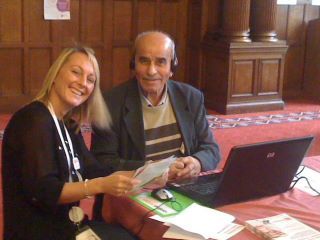
Today I had the chance to help out at the flagship event at Sheffield Town Hall. I met Mr Gul who was an ex-serviceman for the Royal Air Force.  I loved listening to his stories about all the countries he’d travelled to – he’s certainly had an exciting life!  Mr Gul was keen to learn more about using the keyboard, and wanted to learn what all the buttons do and how he could increase his speed when typing.  We worked through the Online basics keyboard course and then did some practice typing.  Mr Gul is an active member of Sheffield pensioners’ group 50plus, and is keen to raise current issues across the city for his fellow pensioners.  He’s now going to set up an email account so he can keep in touch with his old colleagues and email his queries to the council!  He went away very happy with his session, wishing me a Merry Christmas! Arghhhh, a reminder that there isn’t long to go now until Christmas Day!

How Chris gave his hour at Go ON Sheffield

Well we’re only three days into Get online week but what a week it’s been already!

After stopping by several events over just a couple of days I feel like I’ve managed to get a pretty broad insight into the diverse ways the internet can have an impact on the life of someone who doesn’t  yet take it for granted. It’s also been great to see how important Digital Champion volunteers are in making sure the digitally excluded don’t continue to miss out.

My week started at the Sheffield Pensions Action Group (SPAG) where Go ON Sheffield volunteers from Heeley Development Trust and Sheffield Hallam University were working with older members of the community to give them a taste of life online.

Here I managed to have a chat with Jackie, the SPAG secretary who told me how great it would be for her to be able to speak easily and cheaply to various siblings around the world, especially as some of them were struggling with ill health. Although much of Jackie’s family has spread out from their home town of Sheffield they are clearly still very close and it was lovely to see how excited Jackie was at the prospect of getting to grips with something like Skype.

From SPAG it was off to a stall in Sheffield’s Castle Market. A volunteer here, from the Broadband provider Plusnet proved to me how a generation that has grown up with the internet is essential in making sure that the previous generation don’t get left behind. Joanne had managed to make a real difference to her mother’s life by inspiring her to get online, and after a year of encouragement and support she has gone from a complete web sceptic to tracing their family history back almost three centuries online, and has even got in touch with a distant branch of her family who were able to share photos of her own great-grandfather.

Yesterday, I had the opportunity to visit an intergenerational session at King Ecgberts School in Totley, in the south of Sheffield.  It’s in a more affluent area of the city, where you might assume more people were online, but the hard work of local councillor Keith Hill and Charlotte, who works at the school, soon turned up a group of locals who were absolutely missing out.

Imag0398

The school had invited residents of local sheltered accommodation to sit with A-level students who had never known a world without the web. This opportunity to share their expertise with an older generation brought out the very best of the students who without exception were enthusiastic and patient. It was wonderful to see them realise that because the internet is so integral to their own lives, they could make a huge difference to someone else’s by helping them take their first steps online.


How Greg spent his hour for Go ON Sheffield

This week I’m sharing my blog with the team at UK online centres, so you can read what they’re getting up to during Go ON Sheffield. Today, Greg – our Training Delivery Officer –  tells us what he’s been up to today during Go ON Sheffield. 


“I was really excited to a part of Go ON Sheffield because I have spent the last 6 years living in Sheffield and it is great to be able to give something back to the city which has given me so much!

“My day started off very busily, as my first task was to make sure two of our events at Castle Market and the Firstpoint both had laptops with dongles so they could deliver taster sessions to people who wouldn’t normally have the opportunity to get online.

“Once Neil from Heeley Development Trust had arrived at Castle Market and I had got some laptops up and running, ready to be used, I headed over to the other side of Town to Firstpoint, Sheffield Council’s ‘one stop shop’,  where I met (another) Neil, a volunteer from Plusnet. Before I was even able to get the laptop set I was approach by Mohammed. Mohammed is originally from Algeria, and he was really interested to find out more about internet safety. He was specifically interested in this as he’d had a bit of a bad experience before, previously having opened up some spam email which resulted in his computer being infected by (in his own words) ‘pesty’ Spyware!

Photo

“I showed Mohammed around the Go ON website and he was really keen to start learning. We got him registered for Online basics and he got part the way through the internet safety module before he had to rush off for another appointment.  Luckily, we were able to use the centre search on Go ON to find a UK online centre near to him – and he couldn’t believe his luck when we found a centre in Gleadless just 0.1 miles away.  It turns out Mohammed has been walking past the centre every day without knowing that he could go there to find some help. He’s promised to pop in over the next few days to find out more.  

“After an exhaustingly satisfying day, it was fantastic and a real privilege to be part of the starting point in someone’s life-changing internet learning journey. I’m sure that with the help of Gleadless UK online centre, Mohammed will be able to surf the web safely, and have a great time doing so in no time at all!


My Hour for #GiveAnHour

I spent my hour yesterday (Sunday 30th October) in central Sheffield talking to people about how and if they use the internet – and trying to persuade them to give it a try if they didn’t. It was great to have the help of Emma Cooper (@Em_Cooper), in the photo below with one Sheffield interneter enjoying the Halloween Fair.

As I’m into my stats I was surprised to meet lots of people in their 30s and 40s who had never used the internet. Between Emma and I we think that we persuaded about 30 people to get online and to go to one of the 50+ free events happening around Sheffield this coming week.

Go_on_sheffield_sunday_fright_night

Of course we got lots of people who just said “no”. The two most common excuses for not being online were “I’m too old” and “The internet is too dangerous”. It’s was great to have seen the BBC video last week of the 104 yr old man helping his young (89) wife to get online – if he can do it anyone can!

With two women I spoke to, I got the sense that it could be a real turning point for them, and both of them asked “do you really think I could do it?” and “can people like me go to these events?”. They had previously assumed that the internet was something for other people so it was great to reassure them that they could give it a go. 

One man I spoke to will now definitely get online. He said he thought he needed more than an hour – so I reassured him that there was help for him for as long as he needed it. His friend suggested that he could now get “one of them cameras”.

Cost was an issue for some people, particularly younger offline people. The Plusnet offer of 50 free one year’s broadband which is available to Sheffield residents was a significant incentive for some of the people I talked to, and shows just how important having the support of organisations like Plusnet is.

It was good to have the “give an hour” message for the younger people and many of them were going to encourage their grandparents to get online. Unfortunately lots of people had tried to help a loved one get online, one man had even bought his mum a computer, but they had all failed and had decided that nothing was going to help.

There were also lots of people who said they didn’t know anyone offline. It was nice to talk to students in Sheffield whose Grandparents email them regularly and who delighted at how much their loved ones kept in touch online. One woman I spoke to in her 70s told me she didn’t know how she would cope without the internet and thanked us for helping others to get the same benefits that she enjoyed.

I even caused an argument between two women in the late 40s. One online, one offline. When I couldn’t persuade the offline woman that the internet had anything to interest her, they walked off. However Emma heard them walking up the street arguing about why the offline woman wouldn’t give the web a chance. If we didn’t get her online, at least we started a conversation.

This week, I’m giving my blog up to different members of the UK online centres team who will be blogging about how they’re giving their hour in and around Sheffield, so do keep an eye out!

18 million people are willing to give an hour

You probably know by now that I’m a stats nerd, but did you know which set of statistics I use the most? An amazing 30 million people in the UK use the internet everyday [ONS, 2011] with learning and keeping in touch being the most regular online activities [Ofcom, 2011]. Many of us who make up this 30 million learned how to get the most out of using the web through our friends or family members, and have been inspired through this basic interaction.  There are still 8.7million people[ONS, 2011] who have never, ever, ever used the internet – and so it makes sense to use these interactions to inspire them as well.

Earlier this year Martha Lane Fox [@marthalanefox] made a rallying cry to recruit 100,000 local digital champions from communities and corporates alike, and this first milestone has already been achieved. We’re working with Martha and her Race Online team, and want to encourage all of you to Give An Hour as part of the huge national campaign that’s happening over the next fortnight.

We know lots of things about people who are online – and about people who are offline – but we didn’t know that much about the online people (we call them Digital Champions) who would like to help offline people until recently. Because of this, we commissioned some primary research with IFF who surveyed 2,056 representative adults, held four focus groups and found out some interesting things.

Out of the 40 million people who are regular internet users, 45% (18 million) are willing to spend an hour helping someone to get online for the first time. That’s a pretty big volunteer workforce.

Of this 18 million, most have already helped someone get started. Usually the offline person asked for help, and they started with something like email or Google. One person who had helped her Mum said: “It’s about finding that seed of interest, something they really like, and then showing them the link to what they really like.” Sometimes, they had tried to persuade a family member to get online but had met resistance or when they had helped someone to get online they had got frustrated at the experience – they had taken using things like a mouse for granted and hadn’t understood how slowly you need to go with a new internet user.  We’ll work closely with other interested parties on this research, including Race Online and the BBC, who have also commissioned research on Digital Champions.

Our new research shows that of the 18 million that are willing to help, 25% – or 4.5 million people – know someone who is offline. If just 10% of these people respond to the campaign call to action that’s almost 0.5m people who will get onto the internet for the first time in the next two weeks.

Out of the of the 18 million online people who are willing to Give An Hour, a staggering 11.5m (64%) are even willing to help someone they don’t know.  As these people might need a little bit of help to find someone who’s offline,  it makes sense to start thinking about them as volunteers who we can inspire to get in touch and get linked up to someone who is offline outside of their immediate circle.

As an immediate response, we’ve made it easier for Digital Champions who want to volunteer to help someone get online find somewhere they can do this.  You can take a look at this map, put in your postcode, and if you spot a gold star icon, that centre would love to hear from you.  We’ve also brought the map, and a Do-it search widget which allows you to find charity and community organisations who need your help, together on the Digital Champions website, which you can take a look at here.

We’re going further than this though, and our next step is to do some more research, and so that we can rigorously test some clever beta tools with new digital champions and the people they are going to help making it even easier for everyone to give the spare hours they have – during the campaign and beyond.

So, how will I Give an hour? Well, the campaign says that we will all get an extra hour when the clocks go back during Saturday night (29th October), so I’m going to use that hour in the streets of Sheffield on Sunday (30th) lunchtime handing out leaflets and talking to people. I want to see if I can persuade people to give up an hour of their own time to help someone to get online, I want to see if they know anyone who’s offline or not, and I’m always keen to talk to people not using the internet so I can try to encourage them to join our digital nation. I’ll be tweeting throughout, and keep an eye on this blog for an update on how I get on!

Visit www.go-on.co.uk or www.facebook.com/GoONSheffield for more information. 


17 year unemployment high – how local action can help

The announcement today that unemployment has reached a 17 year high has led me to thinking about one of the universe’s age old questions. You’ll be pleased to know that (for today), I am giving the people vs. pipes issue a rest, and instead I’m thinking about what comes first. Rather than chickens and eggs, I’m thinking about getting people online and whether it’s the people or the policy that comes first…

I started thinking about this a few weeks ago after talking to Gabrielle, who has joined my team from a Jobcentre Plus office in Rotherham. At UK online centres, we’ve been working closely with Jobcentre Plus for a number of years, encouraging referral relationships to help people onto the web and into work. In fact, almost 1 in 4 of our referrals now come from Jobcentre Plus, and every Jobcentre Plus now has a Digital Champion whose role is to promote take-up of computers and the internet.  I know the policies are in place to help jobseekers get online but how does it really work on the ground?

Gabrielle says: “Working as an adviser for the Jobcentre, we saw quite a number of customers who didn’t have digital skills. We know that most jobs are advertised online, and not having an email address or being able to apply for jobs over the internet is a real barrier for people.

“Luckily, we had a great Digital Champion – Karl – in our office. He was really proactive, and was always sending emails about UK online centres and new places people could go to get online. He got everyone in the office enthused about what getting online could do for people – not just to help them find jobs but to help them do all sorts of things like keep in touch with family and friends, do their shopping, sell things on ebay, anything they were interested in.

“It’s great that Jobcentre Plus nationally are supporting this and I’m pleased to hear that Rotherham was a good example of how it actually worked. Of course it wasn’t perfect but most of the Advisers knew that helping people to get online was essential to getting them back into work.”

The policy may have come from JCP on high, but it’s the people on the ground making it work. Or maybe it’s these pockets of great practice that have driven the national picture? What’s clear is that people are at the heart of digital take-up.

When we’re encouraging large national organisations to commit to getting people online, it can often feel like a lot of empty promises – all well meaning but easily forgotten. This is why it’s great to hear how it’s really happening, when all the elements come together to create a committed local team who understand how important being online is.

Kim Sweeney, the Digital Champion at Blackpool’s Jobcentre Plus, says, “Since we’ve been working with UK online centres, there hasn’t been a single person who’s failed to get the hang of the computers. It’s rewarding seeing people go from being apprehensive of turning one on to being confident IT users, not only to support their job search but to contact old friends, find out about public services online and organise their social lives. That instant connection and empowerment can make all the difference to people, and to their job search.”

The figures today show that unemployment is at a 17 year high, with more than 2.5 million people out of work in the UK.  I’m sure stats nerds like me will find the BBC’s ‘the economy in graphics’ map very interesting for looking at how unemployment is affecting different regions. Jobcentre Plus and the Department for Work and Pensions are both under a lot of pressure to move mountains, inspire change and ultimately get these figures down – especially in the areas which are hardest hit.  I want to encourage DWP policy makers to look at our example – of a partnership that works, of grassroots action, local expertise and enthusiasm, and ultimately of real change.   The relationship between UK online centres and Jobcentre Plus really works – Gabrielle’s first hand knowledge of what’s happening, day in day out, on the ground proves this.


Getting Leeds online

Last week, I headed to another Yorkshire city to lend a hand in the Go ON Leeds campaign. The campaign was run by UK online centres and Race Online, along with lots of our lovely partners, to encourage people in the city to get online or to give their time to become Digital Champions.

A celebration lunch was held on Friday at Leeds Central Library, and not only did it give me the chance to talk to lots of interesting people but it was also a great way of showcasing the great partners who contributed to the campaign. A big thank you to Asda, the Post Office, O2, Leeds City Council and Leeds Library Services, and many more, for their contribution and for creating such a buzz about getting online in the city. It really does go to show how you can you achieve when you work together!

Another big thank you to Studio 12 who created this great video about the campaign which you can watch here.

Helen_and_greg_mulholland

I was even lucky enough to meet Greg Mulholland (@gregmulholland1 on Twitter), the MP for North Leeds, who you can see in this photo.