As most regular readers will probably know, I’m pretty passionate about the potential of technology to do more for people, and help people do more for themselves. I’m also passionate about its potential to do more for communities, too.
Technology can empower communities, bring them together and help them thrive. The problem is that hard-pressed local and community organisations often struggle to harness its power. For many, it’s difficult to know where to start – what’s out there and how it could help. For others, it’s a matter of time. If you’re running round trying to get things done and make ends meet, then researching and experimenting with digital tools is simply not top of your to-do list. But digital tools can actually help community workers save time, manage their projects and even raise important funds. And there are people out there who are making work – and work hard – for their projects and clients. At OCF we want to capture some of that experience, and make it easier for community organisations to use technology to do more of what they do best. With that in mind we’re running a new Conference next month, which aims to inspire community organisations to adopt new digital tools. Digital evolution, local action is a one day Conference taking place on 27 November at the BT Centre in London. The conference will be chaired by former Labour Schools Minister and Employment Minister, Lord Jim Knight (also our Chair at OCF). Delegates will get to take part in interactive workshops and hear from the experts about how technology can be used to deliver projects, improve services, build communities and organise local action. Speakers will include Minister for Civil Society Nick Hurd MP , Marcelle Speller founder of Localgiving.com, Dan Thompson – the creator of #riotcleanup and #WeWillGather, and Ken Banks, founder of kiwanja.net, which helps non-profit organisations in Africa and around the world make better use of technology. I’m really excited about the conference and the opportunity to give local social innovators new tools to do their day-to-day work – and hopefully more confidence in their personal ability to make a difference. These are the people who are in the driving seat for social justice in Britain. If you’re one of them and feel you could make more of technology to make more of an impact, it would be great to have you join this conversation. Find out more the Conference here or follow the latest news on #dela2012. I’ll look forward to seeing you on the day.Author: HelenMilner
“Goodness! I’m in a Digital Hall of Fame. I shall have to behave myself now”
That’s what Stephen Fry said when he was inducted into BIMA’s Digital Hall of Fame yesterday, and I was really honoured to join Mr Fry, and other luminaries such as Sir Tim Berners Lee, as a Hall of Fame inductee. It’s lovely to be recognised as a digital champion, and to be called “inspirational and influential”, but really I’m accepting this award on behalf of the fantastic people in all of the local grassroots UK online centres who work hard every day in helping people to use the web. Not only are these the people that voted for me, but they’re also the ones who are, without a doubt, doing all the real hard work in bringing the internet to some of the most deprived communities in the country.
If you’ve ever been to a UK online centre, or supported someone with very basic computer and internet skills, you’ll know just how tough a job it can be – and the wonderful people within the UK online centres network do it day in, day out, often without much recognition. So this is for all of you – you’re the real digital champions!
The Olympics, volunteering and the dreaded ‘L’ word
That’s it! With a wonderful late flourish from Andy Murray at the US open last week, our golden Summer of Sport is over! I‘ve been as thrilled as the rest of country by the great achievements at both the Olympics and Paralympics (some I was even lucky enough to witness some first hand), but now the fanfare is dying down, like many I am being forced to consider that ubiquitous ‘L’ word – that’s right,‘legacy’.
While the politicians are facing questions about the sporting legacy of the games, especially for young people, what I want to know now is how we can sustain this new enthusiasm and respect for volunteering and volunteers. A lot has already been said and written about the ‘Games Makers’, the army of 70,000 volunteers that helped crowds get around the Olympic park, drove athletes and officials between venues, and took on many other duties so that the games ran smoothly. Sebastian Coe said they stood ‘among the heroes of London 2012’. What I‘d love now is to see this warmth and appreciation for this group harnessed so we can encourage others to volunteer in communities. It seems fitting then that last week I attended the launch of #WeWillGather, a great new initiative by Dan Thompson (and Lloyd Davis and Sophie Collard), who had such an impact with #riotcleanup last summer. For anyone who’s interested in giving even a little bit of time, it’s a great resource. There are over 20,000 volunteers within the UK online centres network so I’ve seen first hand just how huge an impact they can have – our network simply wouldn’t run without them. This is why I hope, with the help of great resources such as the Do it website and Volunteering England, the volunteering spirit that has inspired us this summer will carry on supporting communities all over the country. PS If you ever feel like saying thank you to the UK online centres volunteers you can post something on our Facebook wall and at least some of the 20,000 will see it.It’s good to share – the third Social Digital research symposium
Yesterday, together with the LSE, we ran the third in the Social Digital Research symposium series which, as always, brought together a group of very clever people, and gave them the chance to talk about what they’re doing, make connections with others interested in similar things, and answer some important questions that will help us do things better in the future.
The theme of the latest symposium was making connections, and I think we certainly achieved this. I’ve called this blog “It’s good to share” as I think it sums up the feeling in the room yesterday. Here are some highlights of the day:- Ellen Helsper (@EllenHel) spoke about proxy users
- Martina Chapman (@ChapmanMartina) gave us a fantastic look at the latest BBC segmentation
- Martin Wilson from @Go_ON_UK spoke about a need for consistent measures
- Nick Breeze from @GDSteam told us about their work in progress looking at typography for helping people to transact with Government online
- Grant Blank from Oxford Internet Institute reminded us that young people aren’t all online
- Patrick Barwise made a very interesting, very sharp argument for increased investment in driving more people online to use digital government.
As well as hearing from a number of really interesting speakers, who did the job of getting everyone asking questions and sharing, we also came away with some really solid answers to where we go next with measuring digital skills, and in turn how we know whether what we’re doing is working.
All the slides from the symposium are on the Social Digital Research ning, and so if you’re not a member already and you’re interested in this kind of thing, I’d encourage you to sign up. It would seem a shame if our online symposium wasn’t just as lively as our offline one. Do go and have your say.
Being the ‘best in Europe’
It’s wonderful doing a talk and getting great feedback. Not just “pat on the back” feedback like this (which is nice):
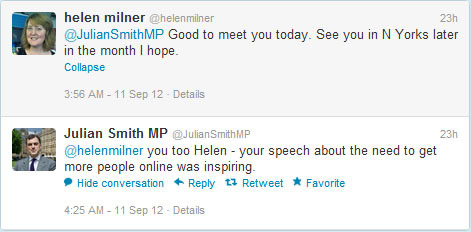
The kind of feedback when you know that people in the room have changed their thinking because of something you’ve said. (It doesn’t happen to me often!)
Yesterday was one of those days. I did a talk was at Westminster eForum’s “Broadband Britain: funding, killer apps, and digital engagement” in Whitehall. The room was packed – apparently a new Secretary of State does that. The organisers were willing to mix together a debate about digital engagement alongside one about superfast broadband and all the technical stuff that goes with that. True to form I said I’d talk about People not Pipes (you can see my blog about that from last year here
In a nutshell areas with poor “normal broadband” infrastructure have high take-up – usually rural areas where the internet is a lifeline to services and communications – and poorer communities with relative good, fast and/or standard broadband infrastructure have low take-up – due to lack of skills, low confidence, fear of failure as well as fear of privacy, and a fear of the costs of broadband. I called for action on both the pipes as well as the people – we need investment in both broadband infrastructure and in support networks so that everyone is skilled to use it. If we work on both elements we can be the “best in Europe” and we will really drive economic growth.
The audience yesterday understood that £1bn public investment in a broadband infrastructure without a close link to an investment in the support networks was quite bizarre. And Julian Smith MP who was chairing the event said he would raise this with Maria Miller as a priority. I’ll keep you posted.
My slides as always are on Slideshare.
Universal Credit and the Select Committee – my ten pence worth
This weekend, I’ve been keenly following news of the Universal Credit Select Committee, and so ahead of tomorrow’s Commons debate (which I’ll also be keeping an eye on) I thought I’d have my say too.
One of the main concerns presented before the Select Committee, and one that will no doubt be debated tomorrow, is the fact that the Universal Credit will be built to be ‘digital by default’ – it will be designed for online channels, and will be managed and run online. Concerns have been raised about the 8 million offline people in the UK, and the 14.5 million who don’t have adequate skills, and the risks that they’ll fall through the cracks without the support they need to claim their benefits or keep their details up-to-date online.
It’s a bold move to build a flagship benefit service as digital by default, and so I can understand why people are concerned, but I think it’s the right approach. I talk all the time about how the internet can really open up lives, and by hook or by crook I’m determined to encourage as many people as possible to use it – and use it more. Building online services that people need to use is a great way of introducing people to the internet, and helping them to gain skills that will positively impact on other areas of their lives too. We released some research back in January that revealed that 73% of employers wouldn’t even interview those without computer and internet skills, so not only will people who are unemployed be gaining new skills by claiming benefits online, but they will also be making themselves more employable.
We know that community centres and public libraries (thousands of whom are our partners) can provide a local and low cost range of solutions. For those who need support – whether they’ve never been online before, want some help with their first claim or want ongoing help to gain more confidence with using online tools. For those who need access if they don’t have a computer at home. Labour MP Dame Anne Begg, chair of the Commons Work and Pensions Committee, said that recently she had been unable to find a broadband service for her own flat at less than £30 a month: “On the kind of income that many people on benefit have, that is completely out of the scope that they can afford,” she said. Getting online at home is of course the ideal, but UK online centres do exist as a local alternative when access at home isn’t a possibility.
Universal Credit is brave and ambitious and difficult, but I believe driving this new service to be digital by default is the right thing to do. We should be brave and ambitious too about improving the lives of people on welfare by giving them the digital skills they need to take part in a 21st century where it is inevitable that having digital skills will be as essential as reading and numeracy.
My thoughts on the BBC’s Media Literacy research report
Last week, I mentioned that the BBC had released some really interesting research into media literacy, and now I’ve had the time to fully digest the report, I thought I’d share with you what I found interesting.
The report makes fascinating reading, and luckily a lot of it reinforced what we already knew – which is always reassuring! Amongst those who are offline, 51% are 65+, 71% are C2DE and 50% have no formal qualification, which pretty much echoes the type of learners who are using UK online centres. People’s motivations for getting online reflect what we hear – 31% of internet newcomers are drawn online by being able to communicate with family and friends, 21% because they could find information to help them with everyday life and 21% to help them research products and services. And amongst all the different groups identified by the report, from the hi-tech influencers to the concerned resistors, all said the first thing they would do to learn more would be to ask someone else for help. But one of the most interesting findings from the research is that 23% of non-users are classed as lapsed users, so they’d used the internet before but aren’t doing so now. On top of this, 4 in 10 non-users class themselves as proxy users, so they would ask someone else to use the internet on their behalf. Together these lapsed and proxy users make up a bigger proportion of the offline population than those who have never been online before, and so it seems only right that we focus more on these groups, and think more about how we can inspire and support them to do more online. 46% of people questioned by the report couldn’t live without the internet – that sounds like me! So for those that don’t use the internet, for whatever reason, it must really feel like the gap is widening, and the online world is further off than ever. It’s great that the BBC has done this new research. Their report provides a really useful insight and we need to make sure future research builds on it; I hope the Social Digital Research Hub can help more people to hear about research that’s taken place. As Secret Affair sang (in 1979!), this is the time for action. Time to work together to support everyone, whatever their level of skill, to take advantage of all the great things the internet makes possible. Time to be seen.7.82 million Britons have never been online
I went to Stratford last Saturday without a ticket for the Olympic Park. My son had got caught up in the Olympic optimism and wanted to see the Park even if we couldn’t go in. We had a lovely day, and when we arrived we were confronted by volunteers with megaphones shouting at us that the only way to buy tickets was online. I know it’s my day job, but I did wonder how that would have felt if you had never used the internet.
Which, according to the latest Internet Access results from the ONS, released today, is 7.82 million people in the UK. This is down 10% on this time last year, which is a huge achievement. And there’s more good news. Following our recent research symposiums, the ONS have, for the first time in a long while, started breaking results down according to those who haven’t used the internet in the last three months since questioning, revealing the numbers of people who – despite having been online – aren’t getting any benefit from computers and the internet at all. There are an estimated 14.5 million people in the UK who have been online before, but don’t have adequate skills to use it, and we’re keen to know more about them, so it’s great that the ONS are recognising this third group, the ‘ex-users’. Of all the adults asked about internet usage by the ONS, 97% had used it in the three months prior to being questioned. This might seem like a bit of a clean sweep, but when you break this figure down you see the real picture. Of those aged 75 or over, 83% hadn’t used the internet in the last three months. Add this to the huge numbers in this age bracket who have never used the internet, and it shows that only 24% of those over 75s are getting any real benefit from being online.The BBC has also recently released some research that shows that, of the total population, 11% are past or proxy users. This research makes a really interesting read, and warrants a blog post in its own right, so keep an eye out for that one! What these figures do show is that while inspiring people to go online for the first time is one of the challenges we face, it’s certainly not the only one. We need to understand better what keeps people coming back to computers and the internet, what encourages them to keep developing their skills, and how we can support ex-users so they too can take advantage of all the benefits being online can offer. I hope we can discuss this further at our next research symposium, and I’d be very interested to hear your thoughts either here or over on the Ning.
By working together, we can really have an impact
One common theme in everything I seem to blog about is the importance of working together. We couldn’t support people to improve their skills, and we certainly wouldn’t have been able to help one million of them in just over two years, without working together with our fantastic network of community partners.
I’m a big advocate of working together, so it’s great that I can talk about a project that has done just this, resulting in positive outcomes for a whole city. We kicked off the Sheffield Channel Shift project late last year. Sheffield’s our home city and we’re pretty passionate about it. Unsurprisingly, we’re also pretty passionate about the internet, and what it can do to make people’s lives easier, as well as to save the government money. So it seemed natural for us to bring these two together. Thus, the Channel Shift project was born. The project aimed to bring lots of different partners, including Sheffield City Council, Jobcentre Plus, the Department for Work and Pensions and Citizens Advice Bureau together with some of our local UK online centres, so we could work out just what we needed to do to encourage people to move transactions online across the city. We completed the project in April, and one of the main discoveries was that it’s really all about culture change, and ensuring the staff at every level buy into the project, and can understand the online services that are available and why they should be promoting them. They also need to be able to direct customers to where they can go to find help and support. A joined-up, partnership-led approach is the only way to make this happen. The project was a real success, in lots of ways. 75% of people we surveyed after the project said they could now access services online, with 23% estimating they had reduced calls or face-to-face interactions by 10 a month, representing a huge saving.And not only did we have a real impact during the life of the project, but we also established partnerships that will continue way into the future. Our partners will continue promoting the benefits of the internet, and will help people find the support they need to use it. They’ll continue to save the government, and organisations, money, and they’ll continue to make people’s lives bigger by opening up new worlds. This is why I think the Sheffield Channel Shift project has been such a success, and why I’m keen to see it replicated across the country. You can read more about the Sheffield Channel Shift project, including the full report, and a video featuring some of our partners here.
People vs pipes again – the House of Lords Broadband for all report
This week, the House of Lords Select Committee on Communications published Broadband for all – an alternative vision. The report acknowledged something that we’ve known for quite some time – that people and businesses are being left behind due to a lack of access to computers and the internet.
The report focussed on the fact that government is more preoccupied with speed than with universal access, and made a number of recommendations to ensure we can bring access to as many people as possible throughout the UK.
While I welcome the report, and such a public statement of just how important the internet is for individuals, communities and organisations, I for one felt quite bamboozled by all the jargon, and talk of spectrums, dark fibre and point-to-point FTTP had me lost. For me, this is the real difficulty I found with the report, and it brings me me back to an issue I’ve discussed at length before – one of people vs pipes. Of course, having the infrastructure in place is essential to ensuring we can become a fully digital nation, but by putting all of our eggs into the broadband basked we’re ignoring what is a far bigger issue – that of skills.
8 million people have never used the internet before, and around 14.5 million do not have adequate skills to get any benefit from it. That’s over 20 million people, a third of the UK population. Whenever we talk about being a digital nation, and where we want to position the UK in the digital league table, we need to remember these 20 million people, and ensure that by investing in better pipes we are not leaving them behind.
Despite the technical jargon in the Broadband for all report, for me the pipes is the easy bit. Sure it takes investment, and a huge number of people working together, but we know we can achieve it. What I’d like to see now is an equal or greater commitment to the difficult job of upskilling these 20 million people, something that UK online centres throughout the country are doing every day, with very little funding. For me, this is the real challenge, and one I hope will be recognised.
We’re keen to join up the people with the pipes, so we’ll be soon be publishing a link to all of broadband plans submitted by local authorities, and we’re hoping to help support the demand stimulation side of these plans. I’ll blog more about this in the coming weeks.
 Helen Milner