
We’ve just launched a new report into informal adult learning, and how it has changed, which I think makes some really interesting reading. You can take a look at it on our website.
I’ve seen first hand just how big the internet can make people’s lives. I’ve spoken to hundreds of people in centres who have picked up new skills online, or had the world of learning brought alive to them. My own nephew even learnt to play the piano on Youtube, which would have seemed fairly unbelievable only a few years ago. The great thing is, this research shows that very informal learning is taking place all of the time on the internet – people are watching videos on Youtube that teach them how to change a washer on their tap, they’re finding information about the history of their local area – and best of all they’re connecting with others who’ve got similar interests, and they’re sharing their findings pretty widely too. What this research shows to me is that our old definition of ‘informal learning’ is a bit defunct. Only 25% of people are classing themselves as having taken part in informal learning, but 58% of people have used the internet to discover more about a hobby and 42% have watched a video online that taught them something new. We often think of men as being somewhat forgotten in the informal learning area, but they’re embracing it under the new definition – they’re even participating in online discussion groups more than their female counterparts. The research also fits in with my new favourite stat. According to NIACE’s Annual Participation Survey, only one in three people have done any learning since they left school. Ofcom’s 2011 report, however, asked people about the things they are doing online – and revealed that 73% of people are learning online. To me this presents a huge opportunity – and having just supported one million more people to get computer and internet skills, we can help many more to open up new worlds through learning online. That’s why I’m delighted about the eReading Rooms pilot I blogged about recently. I’m pretty sure we can bring the huge power that the internet has to the hardest to reach people in some of the most deprived communities in the country, to ensure they don’t have to miss out on the online learning revolution. Watch this space for more!Author: HelenMilner
Smartphone usage up again, Ofcom report reveals
Earlier this week, we learned that texting is in and phoning is out, according to Ofcom’s annual communications market report. This rings true even if I just take my own household’s use into account.
The statistics I found really interesting in the report though were those on smartphones. As the owner of not one but two smartphones, I wasn’t surprised that 39% of adults now own one – up 12% on just two years ago. But what did surprise me is that for 42% of these people, the smartphone is their most important device for accessing the internet. This is a huge increase on previous years, and will have a massive impact on all of us working in the digital arena. I blogged a couple of weeks ago on our latest research symposium, and the difficulties we’re having in defining people as offline or online. Smartphone use adds a whole new element to the debate – if someone only has a smartphone will they be able to access all of the tools that a truly online citizen can? Will they, for example, be able to claim Universal Credit with just an iPhone – I for one know just how fiddly even booking cinema tickets can be on these small screens. What the report does suggest is that we may be heading towards different tiers of internet usage, with the multi-deviced, always connected 21st century consumers at the top, and those who aren’t connected at all at the bottom – with the divide between the two widening even further. Measuring and commenting on our behaviour – and even devising new words like “turfing” to describe it – only highlights how much those without skills are missing out, and how far away we are from being a fully digital nation. And this isn’t a problem that even the cheapest of tablets can solve. Which means that I will continue to shout from the rooftops – and talk to anyone who will listen – about the importance of investing in supporting people by giving them a helping hand from a patient local person.Onward to the next million!
“Most of us take for granted using the internet to stay in touch with friends and family, find a new job or order shopping. That’s why it is fantastic news that UK online centres have helped more than one million people to access the web. Digital skills change people’s lives for the better helping them to feel part of a modern society” said John Hayes MP, Minister for Skills and Lifelong Learning, today in a heart warming speech he gave to a small group of UK online centres learners, volunteers and staff.

It really is the best bit of my job talking to learners whose lives have been given a massive lift because of digital technologies. Vicky from Cambridgeshire was with us in Westminster today and told John Hayes and me her story. Having left school without any GCSEs and little confidence in her literacy skills and after her children started school themselves she began attending UK online centre sessions at her local pub and hasn’t looked back since. In fact she volunteers twice a week at The George in March to make sure other local people get the digital skills they need.
Helping one million people learn the digital skills they need to use the web may have been one of our biggest achievements to date, but we’re always looking forward to the next big thing. That’s why John Hayes today announced Online Centres Foundation’s role in leading an exciting new eReading Rooms pilot project.
The eReading Rooms project is a six month piece of action research testing the concept of community locations offering access to a wide range of informal learning through technology. It could be on laptops or it might be tablets, smartphones and e-readers. Anything that makes it easier for people to learn more about what interests them, whether that be gardening, parenting skills or their own family trees, or even getting a bit better at spelling or understanding household budgeting.
I’m excited about this initiative as it has the potential to dramatically increase the numbers of adults engaging in learning, particularly people who didn’t have a great time with education the first time round or who haven’t been interested in learning since leaving school (and that might be 50 years ago). We’ll have twenty UK online centres involved in this research programme and I’m confident that we can show the positive effect that access to technology and informal learning can have on both communities and individuals. We’ve seen it time and time again in learners like Vicky – people who don’t think learning is for them and then end up going on to do more and more.
Today’s celebration marked one million success stories like Vicky’s and I’m really looking forward to hearing many similar stories in the future. With projects like the eReading Room pilot we’re definitely moving in the right direction.
Wth over 20 million more still lacking the basic skills to use computers and the internet, we need to remember we have a long way to go but the Skills Minister is positive, saying: “This million represents extraordinary progress and I’d like to say thank you to everyone that made this progress possible. Now lets go for the next frontier, the more distant horizon and use this progress as a springboard to get there.”
Technology4Good Awards 2012
 Roger Darlington is a member of the Online Centres Foundation board. Here he guest-blogs about the recent Technology4Good Awards.
You can read Roger’s regular blog at http://www.rogerdarlington.me.uk/commswatch/
A few days ago, in my capacity as a Non-Executive Director of the Online Centres Foundation, I attended the Technology4Good Awards at the BT Centre in central London. It was the second such event and, as last time, it was admirably hosted by the media presenter Mariella Frostrup.
This year, there were around 200 entries with 24 shortlisted and eight winners. The first award to be presented, the Community Impact Award, was sponsored by Microlink and UK online centres, so the latter’s Chief Executive Helen Milner was on the stage for the presentation. Runners up were Riots Clean Up and On Road Media, but the winner was the Stroke Survivors Group which is actually a member of UK Online Centres.
The Stroke Survivors Group meet each week in Paignton library working at their own pace using the Go On online website and other websites and programmes. The library has only been open one year and is a fantastic community resource. This project started with one person – Colin – who plucked up the courage to attend a computer course after surviving more than one stroke and we have seen his drive and vision result in opening up new horizons not just for himself but for many others too.
In association with the library and the Stroke Association, a weekly group was set up and has proved to be a great success. As the first support group of its kind, this groundbreaking project is creating user-led models of good practice that can be adapted to other community and/or clinical settings around the country. Colin understands this and is now determined to push for this model to be rolled out nationally. His vision is to develop partnerships between the Stroke Association, UK online centres and local communities to set up similar groups to aid the recovery of stroke survivors around the country.
The Stroke Association Coordinator says that this group, in addition to its role in developing computer literacy, is having a profound and positive effect on stroke survivors communication and sense of ’belonging’ in the community. Recovering from a stroke is not just about learning to talk and walk again; it is about wellbeing, community, and building belief and confidence in individuals in order that they can see and re-build a future after a devastating event.

Members of the Stroke Survivors Group enjoying a spot of lunch to celebrate winning the Community Impact Award.
From left to right: Doreen, David, Charlotte, Susan and Liam.
On personal note, I was delighted to see The Stroke Survivor Group win this award because my mother suffered very badly from a stroke and I know the devastation that it can cause.
You can access the Group’s current web site here.
Bingo! A great Community Hub + a Minister
Yesterday I was lucky enough to get to visit one of our great Community Hub projects which is based just down the road from our Sheffield office. The Lifewise Centre in Hellaby (Rotherham) really is using technology to bring about change in their community they’re running some fantastic projects currently using technology to tackle gun and knife crime as well as literacy problems.
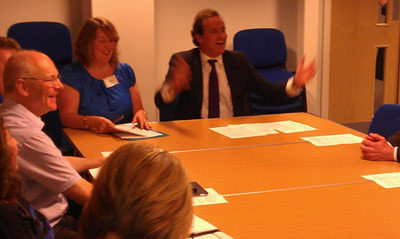
I was at the centre to mark the development of our new website, the Big Community Hub, along with the Minister for Civil Society, Nick Hurd, and Annika Small, CEO of the Nominet Trust who is funding it. This new website will bring together the best online tools that community organisations need to work more efficiently so they change spend more time doing what they love and having an impact in their local community.
And so it wasn’t just me bending the ear of the Minister, we invited along a selection of community leaders who talked about the challenges of their role, and why a resource like this will be so useful. I’m pleased to say he was impressed – with the centre, the local Community Hub programme, and with the ideas for the Big Community Hub.
In fact, he said: “Rarely do I have a real Bingo moment! But this is one of them. I’m committed to helping community organisations build their capacity, and I’m a passionate advocate of technology. So often do I hear that community groups don’t have time to get to grips with digital tools and right here we’ve got the right platform to bring local people and tech together. I’m looking forward to seeing the Big Community Hub website when it’s ready for wide-scale use, and believe it will be a vital tool for the country.”
Take a look at our video on why the Big Community Hub is such a useful resource:
The Big Community Hub website will be launched later this year, and will be piloted in Beta version this summer. Keep an eye on my blog for more details.
Finding a common language at our research symposium
Yesterday we held the second Social Digital Research Symposium of the year. Last time I blogged about how important these types of events are for bringing like-minded people together to share our thinking and our research. Collaboration in this area is becoming ever more important. With a gap between the 8 million who’ve never used the internet and the 11 million who aren’t or can’t use it at home (ONS), there’s clearly work to be done. Whether we refer to the “narrow” users or compare the “nevers” and the “littles”, or the “first generation users” and “next generation users” (OxIS, not to do with age), there’s plenty of agreement that we need to help people move on to the next stage of internet use if we truly want them to independently reap the benefits of being online.
Yesterday we agreed that a common language will help us to share our research more easily, and from the kinds of ideas that were being discussed yesterday I’m certain this can only be a good thing! Our discussions were interesting as well as revealing, throwing up some gaps in the data that we currently have. Sharing what we know is a great way of highlighting what we don’t know, and is a massive step in figuring out where to go next.
One interesting theme that came up throughout the day was the idea that we can learn from studying the exceptions to the rule. While we know who is disengaged, we don’t know what drives their disengagement. What we do have data on however is what drives the kind of person who does choose to take that first step in getting online; this knowledge could help us in reaching the disengaged and combat the barriers and fears that prevent people becoming confident internet users.
Once again we were keen to emphasise the massive link between social exclusion and digital exclusion and would like to know if any action research studying the combating of social exclusion uses digital tools at all. If you know of something please let us know.
Big thanks to all who attended the symposium, particularly Cecil Prescott (ONS), Julia Rulf (Ofcom), Ellen Helsper (LSE), and Kate Cook (GDS) who all presented research. I suspect many have gone away with new angles on old problems, and there were certainly many promises for action back at the respective ranches to add to the collaborative pot.
We’ll be getting together to continue the good work at the next symposium in September. In the meantime there will soon be lots of great slides and presentations from yesterday up at http://social-digitalresearch.ning.com/ and we hope the discussion will continue online … after all, we should lead the way and talk about digital using technology as well as face-to-face!
Celebrating the ‘one in a million’
Today we’re holding a fantastic celebration as we’re on the cusp of having supported one million people (which is a pretty big number) to gain basic internet skills since April 2010.
Helping this many people to learn basic internet skills in just three years was an ambitious target to set ourselves, and it meant scaling up delivering and engaging hundreds of thousands more people, which was a pretty big ask. I’m delighted that, nine months ahead of schedule, we are just about to hit this target.
Of course Online Centres Foundation and all of our partners played a big role in reaching these one million people, but I want to express my admiration and thanks for the thousands of local community organisations and public libraries that make up the UK online centre network, and the staff and volunteers who work in them, who one by one helped one million people to use the internet. Thank you.
As many of you know, I’m a bit of a stats nerd so I wanted to give you a bit more detail about the one million people that we’ve supported.
- 99% of them rated the service they got both from us (online) and more importantly from their local centres as excellent or good
- 88% of the learners feel more confident overall (not just in their internet use) and 79% think that they are now more independent since learning more about the internet
- 38% of this 1 million people supported had no qualifications, and 79% of them are socially disadvantaged.
These stats go to show that we’ve supported many people who aren’t reached by other kinds of informal learning. And also that those we help really like both their experience and the world that has opened up to them since gaining new skills, which is pretty important.
However (and there is always a however!), in today’s world it’s not good enough just to make people’s lives better. We also need to think about the value for money that we provide – and how we can prove this to the people who fund us in government. And so we’ve been calculating the impact we, and our one million learners, have had on the economy. 8% of these one million people have gone on to get a job due to the help they got in a UK online centre. This might not sound like a huge number, but when you remember that it’s 8% of 1 million people, that’s 80,000 people now in work and using their digital skills.
On top of this, by helping so many people to gain the skills they need, we’ve also been able to help with the roll-out of digital Government services – and here we’ve got some very good news to report. For the three year investment of £30m the Government awarded us in 2010 to support these one million people, they’ve already reaped a saving of £185m due to these digital citizens choosing that instead of contacting government face-to-face or over the phone they’ll do it online instead. And now they’ve started, these on million people will keep providing the Government with a £157m saving every year, year on year, from now on.
There are three magic ingredients to how we made this happen: Firstly, our national organisation – Online Centres Foundation – has demonstrated that we can deliver a large scale ambition. We said we could scale up delivery, and we did. Secondly, we’ve achieved our ambition by using technology for everything we do, including to deliver consistent systems and excellent online learning And, thirdly, and most importantly, we do it with thousands of local, or even hyperlocal, partners working in the communities they know and love.
One million people is easy to say, and it’s easy to forget that this short phrase is made up of one million wonderful individuals who were willing to learn something new. To recognise their achievements, we’ve put together a short film to celebrate each and every one of them, who are all “one in a million”
So, thank you to all our national partners, to Martha Lane Fox for all her help, to all of the trusted and hard working staff and volunteers and the thousands of local partners, and to all of our learners for being on this journey with us.
There are still 20 million people in the UK who can’t use the internet to do simple tasks and so there is still a lot to do. We will continue to support all our centres throughout the country to continue what they’re doing, in helping people in their communities to gain basic internet skills. Here’s to the next million!
Financial inclusion and digital inclusion – they’re one and the same
What with all of the hustle and bustle of last week’s conference, and of course the long bank holiday weekend, you might have missed the fact that last week we launched a brand new online course – Make Money Work.
Launching it at the conference really did feel like perfect timing (I love it when a plan comes together!), with so much talk of the launch of Universal Credit. Lord Freud summed it up perfectly for me at the conference when he said that digital inclusion and financial inclusion go hand in hand. If you’re digitally excluded, you won’t bank online and so you can’t check your balance easily. If you’re digitally excluded, you can’t look around for discounts and the best savings accounts or credit card rates, and you’re unlikely to pay your bills by direct debit and to take advantage of the savings this can provide. Put simply, you’re excluded from getting the most out of your money. Universal Credit will reflect the payment pattern of a salary, so it will be paid into a bank account as a monthly payment. If someone is getting housing benefit to pay their rent it will be paid to the person and not directly to the housing provider, so it’s very important that people recieving Universal Credit have a bank account and get the help they need to budget monthly. Our new Making Money Work online course is pitched at a level that’s easy for everyone to follow, and introduces people to the basics of managing money, including things like budgets, saving, borrowing and planning for the future. It’s just a start – there’s another course in the pipeline. We know that digital inclusion and financial inclusion go hand in hand, and we want to do more. If you’ve got ideas for how we can help to link digitally excluded people up with the tools and skills they need to help manage their money, whilst we’re helping them to use the internet, please let me know. In the meantime, do take a look at the Make Money Work course here.My verdict on ND2012
I’ve had a great last few days a the National Digital Conference, ND2012, meeting some fantastic people, sharing ideas and learning lots. We’ve all done a lot of talking over the last few days and so I thought I could better sum up the conference with some photos! In my speech on day 2 (you can look at the slides here) I described what we do as being about local + technology + scale, and I think this works pretty well for the conference as a whole!
Local

Above is a picture of one of our star centre managers, Paul Davies, from Destinations@Saltburn, who won an award at the Digital Leaders Dinner on Wednesday. I said in my speech that it’s all about people, and that’s definitely true! It was meeting people like Paul who made the conference so inspiring, so congratulations to him and all the other centres doing great work in their communities.
Technology
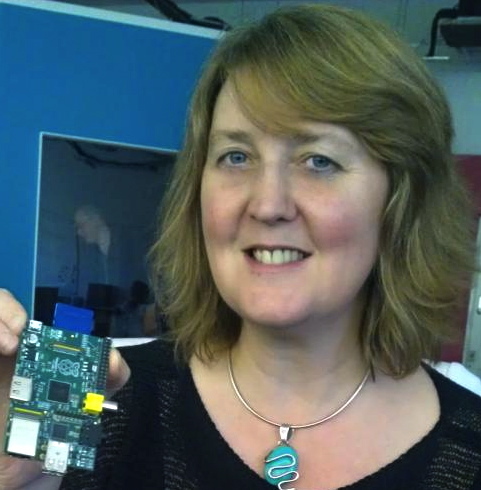

The conference was really all about scale – bringing lots of local organisations together to share ideas and knowledge. The above photo is a group of our centres squirrelled away in an upstairs room at Old Billingsgate, plotting for our next campaign – Get online week, which we’re hoping will be our largest campaign to date, getting tens of thousands of people online.
Thanks to all who inspired me at this year’s conference, and I look forward to seeing you all again next year!Rethinking the digital divide – my presentation from ND2012
View more PowerPoint from Helen Milner
 Helen Milner