How do we measure miracles?

It’s my last day in the US today and I’ve been bowled over by the friendship and positivity of the Americans I’ve met. The libraries, community centres, and various intermediary organisations I’ve been talking with are as committed as we are to great, local and relevant digital inclusion support. And we’re all struggling with working out how to use our precious human resource for maximum impact and helping as many people as we can to benefit from the web.

One thing I’ve been talking about is the ‘network effect’ of working collaboratively. For my day job that means working with 5,000 UK online centres and access points – having a shared vision of a better connected society, a clear voice to policy makers and corporate partners, and a great platform, Learn My Way, for data collection and evidencing our outcomes and impact. I blogged a few weeks ago about the Network Webinar I led where I got the chance to talk to UK online centres staff about their perceived value of the network (“the best bits”), the societal issues they have to deal with, and how we can find better solutions by working together. That is what I mean by the ‘network effect’: realising greater impact by having a shared goal and by working together to achieve it.

I got great feedback following my SHLB presentation yesterday on “Measuring the impact of digital inclusion at scale”. You can see the slides here. There are lots of very familiar stories at this conference, of exceptional local people giving time and patience to help those lacking the confidence and capability to use the web, and of people whose lives have been transformed with new confidence and self-worth, as well as jobs, friendship and fulfillment. In my session I talked about how do we measure the outcomes of this amazing work and how do we value this transformation, the impact. One way Tinder Foundation do this is with data and surveys – we do the math. Our surveys show that 84,280 people have moved from no job to having a job in the past four years via UK online centres; we know that the saving to the UK Government of someone getting a job is at least £8,000 per person per year; that’s a £678m saving to the UK Government (over $1bn in American). And that’s not mentioning the £232.4m saved in people moving from face-to-face and telephone contacts with Government to online services, or the £137m added to the UK economy by 132,440 people starting volunteering in their communities.

Helping Roger to move from 10 years of homelessness to volunteering in a UK online centre (in a hostel) to a job to a promotion (a better job) where he is helping other homeless people to get an education and get employment, is a miracle.

Turning a c. £35m investment in a digital literacy programme (not a work or employment programme) into a saving of £678m ($1.115bn) “just” by helping 84,280 people into work is a miracle too … and one that we can measure.

Philadelphia & Partnership: Digital Inclusion in Action

I’m in the US this week, mainly to speak at the SHLB (Schools, Health, Libraries, Broadband) conference – but of course also to meet people and hear about their digital inclusion experiences across the pond. It’s strange being so far from home and for lots to be so different, but for so much to be familiar too.

One thing I was really looking forward to was the trip I made yesterday to Philadelphia. In the US there was a big federal funded programme called BTOP (Broadband Technology Opportunities Programme) and the City of Philadelphia and partners received a three year grant to establish 80 Public Computer Centres, to train people to use the internet and to encourage Broadband Adoption. Obviously this echoes the UK online centres network, and I was curious to see the results of this model in America.

The programme was in fact a great success and completed in June 2013. The City of Philadelphia is now supporting 44 of those centres – 19 run by the Parks & Recreation Department, 5 run by the Free Library of Philadelphia (the public libraries), and 10 supported in the community. Yesterday I visited two centres in North Philadelphia; the Mercy Neighbourhood Ministries centre supported by the Philadelphia Free Library (PFL), and the Martin Luther King Rec Centre supported by Parks & Recreation.

The communities these centres serve are ones where unemployment and poverty are high, and opportunities are limited. The learners I met were mostly looking for work, and just like with the UK’s Universal Jobmatch system, they needed needed to be looking and applying online. Health was another key theme, which also echoes our priorities back home. Ben – a manager for Parks and Recreation – said that when Obamacare was launched they set the homepage for all of the computers in their 19 centres to the Obamacare site.

At the Mercy Neighbourhood Centre I met Executive Director Sister Ann. Her centre is a multi-use centre focused on supporting local people – adults, children and families. The Sisters are committed to doing what’s needed to make sure local people are safe, supported and fed. They have a day centre for adults with severe disabilities and dementia, providing essentials such as food and showers. The support for children looks exceptional – day care, pre-school breakfast clubs, after school ‘cold supper’ and homework clubs.
FIGHT Launch_Client Support

The computer centre is well used by local people – looking for work mostly, plus people who have never used the web before and need help with the basics. They get support from Ashton – the Digital Resource Specialist (DRS) provided by the Library, and the broadband is provided by the Library too. I was impressed that you can join the Library online and get the online services there straightaway – so in theory someone can join the Library at the Mercy Neighbourhood Centre and then get help and support from Ashton to download an e-book onto a phone, tablet or e-book device. The multi-use centre is bright, sunny, and colourful, and it truly does feel safe, full of love and opportunity.

I don’t think we have anything like the Parks & Recreation Department in the UK, and if we do I’ve never met them on my digital inclusion visits before! In Philadelphia there are about 150 Rec Centres – a building alongside a community basketball court, a baseball pitch and a children’s playground. The buildings support indoor sports and after school clubs.

In the UK the closest thing we have is probably Leisure Centres (big places in the centre of town usually). In Philly a Rec Centre is much more of a community space, and much less plush. Philly has a similar population to Birmingham UK, and has 150 Rec Centres. That’s pretty impressive. Ben and Kevin support 19 computer centres inside the 150 Rec Centres, and the Martin Luther King Rec Centre is one of the larger ones. They encourage the Seniors (adults) to come before 3pm to get quiet time and more one-on-one support from the Centre Support person. After 3pm it’s all about the children, who arrive and spend time playing games, using the computers, kicking a ball around or climbing in the playground. Krystal runs this centre and is clearly adored, trusted and respected in equal measure by adults new to the web and the after-school kids alike.

The City has stepped up and sustained this programme after the federal money ended. It is clearly making a lot of difference to people’s lives and the benefits we often talk about around tangible outcomes such as jobs, communications, access to benefits, and saving money. What’s more, the less tangible benefits are also there in spades – improved confidence, self esteem, and perhaps most importantly, aspiration.

The only thing missing in my mind was Learn My Way – or something like it. The excellence of the support in the centres depends very much on the number and previous web-experience of centre users coming in at any one time. Krystal told me that if someone completely new to the internet comes in and she’s busy she books a session with them to come back at a quieter time – as her only resource is herself. Both Krystal and Ashton help people learn how to use the web in their own way and using their own knowledge and experience. While it’s clear they’re brilliant at their jobs, I wonder if sharing this knowledge and experience and building on something like Learn My Way might make them more effective in busy times? What’s more, they’d have the data on performance, too, and the evidence to show why they should keep being supported to do what they do so well.

I want to say an enormous thank you to Ashley Del Bianco who I met last year at SHLB (after doing some research on the web and already being impressed with her work). I am sure that much of the success in the Philadelphia partnership is down to Ashley’s collaborative style, expertise, strategic vision, and sheer hard work. Thank you to Ashley for showing me around, and for her hospitality. And the very best of luck to her, Eliza, Sister Ann, Ben, Kevin, Krystal, Ashton, Harry, Brian, and Scott – just a few of the fantastic and inspirational people I met.

I can’t wait to see what tomorrow brings.

Listening in Cyberspace

Balancing the decision of when I need face to face meetings and discussions instead of having those discussions online instead is just one of the multitude of new decisions I and others need to make in an increasingly online world. When I watched Evan Davis’s Mind The Gap programme recently I learned the term “agglomeration economics” which to my simple mind seemed to mean people like to meet people in person and by building personal relationships businesses thrive (or something similar).

So, coordinating a network of 3000 centres and 2000 access points, all with diverse ideas, needs, issues and opinions, how can I make sure I and the team spend as much time as possible talking and listening, learning, iterating and evolving?

Previously our network focus groups have taken place face-to-face, twice a year, and they’ve been invaluable. We’ve found out what’s happening for centres and learners, what they think of Tinder Foundation’s services, and what we can do to make things better.  And centres have made friends, shared best practice, and gone away with new tips, contacts, and often new ideas and plans for their centre.  

But, it’s only twice a year, we paid people’s travel costs but not for their time (including travel time which could be considerable), and this way of working inevitably excluded some people. So we’ve taken them digital!

Here at Tinder Foundation we’ve been running webinars for many years.  For those not familiar with the term, it’s an online seminar, where you can see a presenter’s desktop, chat with peers and interact through speech, online chat, voting, messages and ratings.  It’s been a great way for us to offer training to stretched UK online centres staff who can’t afford travel or time away from the coal face.  

It’s very hard to replicate the type of informal networking and interaction you get over a cup of tea and a biscuit.  But this week I think we did it – or took our first steps towards it.  

I took the first session this week, and I frankly can’t wait until it’s my turn again. Participants came from all over the country – from Edinburgh to Exeter – and we’d made sure to prime people about how the session would work, and asked them to come prepared with questions, examples and ideas. It can be too easy to hide on a webinar, and be passive rather than active, which is why we put so much time in up front to make sure everyone was ready and waiting to contribute.

Our conversation was wide ranging, but one of the key things I’ve taken out of it is how important it is to our network that Tinder Foundation paves the way for local partnerships by acting on a national level. That includes work with organisations like Asda, McDonalds and even Jobcentres, who are national organisations with a local presence. With all of these partnerships there were pockets of fabulous practice, but also frustrations about local relationships.  

Many centres are overwhelmed with referrals from JCPs, as they try and get clients up to speed on DWPs new online systems.  But others felt they could be taking on more clients, and helping to triage job seekers more effectively.  That’s something I think we can help with from a national level, and I’m going to take that back to our colleagues at DWP as soon as possible.  

I’m looking forward to seeing how this new feedback cycle can work to make both UK online centres and Tinder Foundation more effective.  I’ve learned all over again that it’s good to talk, but great to listen. And that technology can help all of us do more of both.  But I’ll always still like meeting people with a cuppa and a biscuit too!

Discussing the local digital future

Yesterday I spent the evening at the BT Tower in London, chatting with local authority managers, central government digital teams and a whole host of interesting and inspiring Thought Leaders about technology, the future and local services.  

The Local Digital Futures event was part of a wider Local Digital Campaign led by the Department for Communities and Local Government (DCLG), and UKAuthority.com.  The aim is to support the delivery of excellent, seamless services to users at a local as well as a national level.  

We heard from Deloitte that there’s a big appetite out there for better online services, and from Future Cities Catapult’s Dan Hill about how to work iteratively to achieve them.  BT futurologist Nicola Millard also talked about how people really just want an easy life, and a future trend in digital consumer services will be “Easy” (making it as easy as possible to use, to transact, and to buy).

It won’t surprise anyone to learn that I was there to talk about digital inclusion, and how vital it is in the development of local services.  We need to make online services as good and as simple as possible, and we need to put in place programmes to bring along the 11 million people who currently don’t have the skills or confidence to use them.  

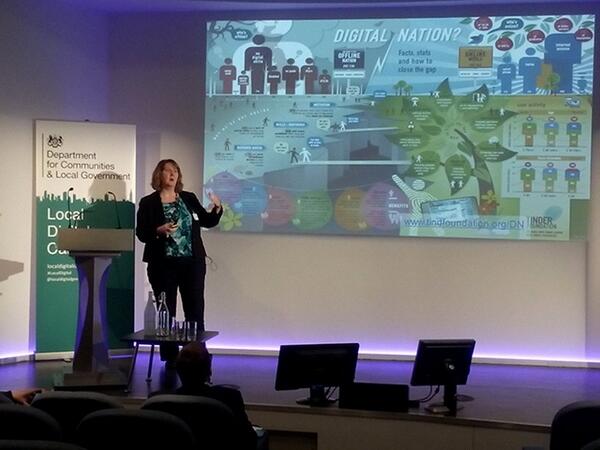
This is fundamental to Tinder Foundation’s thinking, and I talked about the picture of the Digital Nation we’re currently living in, and the vision we set out for a 100% digitally included in the recent A leading digital nation by 2020 report earlier this year.  

It’s great to see that digital inclusion is becoming central to DCLG and UK Authority thinking, and last night there was a commitment to it becoming a key underpinning strand of the campaign as it develops, and that’s only going to be a good thing for local services and local people.   

I have always said that leaders need to embrace the transformation that digital is bringing to our lives and to our work: embedding a digital strategy is a change programme not a technology project. This view was echoed by local authority leaders, technologists and digital planners; people are aware of the challenge we face and aware of some of the existing solutions. The UK online centres network, for instance, operates at a hyper-local level AND on a national scale, and some of the conversation that went on into the evening was about how Local Authorities can interpret this to achieve the Local Digital vision.  

Maybe we just need for a few Local Authorities to group together and work together to make Local Digital happen – to take risks together, make investments together, and to innovate together.  I hope it happens, as it’s only in doing so that they’ll be able to be brave, share the burden and eventually reap the rewards.  

Image

With thanks to @lindasasta for the Twitter pic.  Follow #localdigital for more.  

The power of technology for learning and why creating together is better

As part of our pilot programme with the Department for Business, Innovation and Skills that aims to open up the informal learning to those that wouldn’t normally access it, the fantastic tech team here at Tinder Foundation have been creating something quite special for the Learn My Way website. It’s a Course Creator tool that will allow pretty much anyone to make an online course for their learners – based on their individual needs – while still using all of the infrastructure and data capture from the Learn My Way site – and sharing it too.

And last week, our first group of intrepid content creators came together – at the London offices of Mozilla – to start building their own courses. We’ve always known that grassroots organisations know their audiences – and what they want to learn – best, and so it makes sense to give them the tools to create the online learning content that’s right for them.

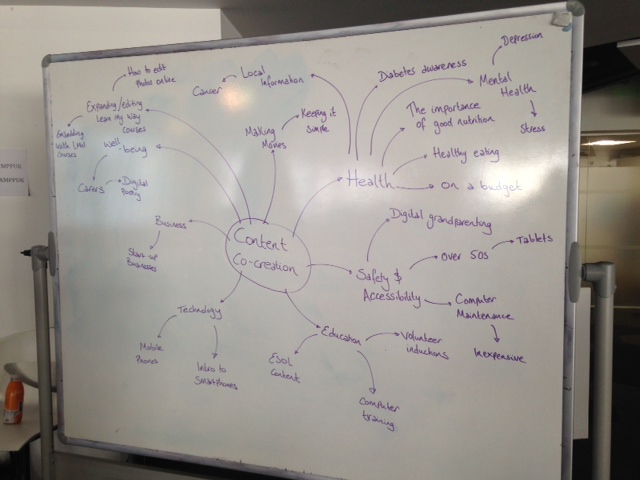
The course creator was unveiled for the first time on Thursday, and by the end of the day we’d already made some great progress with a number of courses well on their way to being finished, with lots more in progress. And the diversity of courses created, started or talked about shows just how useful the course creator can be. Courses included healthy eating on a budget, digital grandparenting and coping with cancer, and that was only in a small group.

Image

We’ve been piloting co-creation too, in the run up to launching the new tool, and one really interesting aspect is where local centres are involving their clients/users in the process of designing and creating an online course, and therefore making it perfect for the intended audience – learners just like them. We all know that showing others is a great way to learn yourself, and now we’re putting some relevant tools in the hands of people in local communities to make that happen. This could be very interesting as Course Creator rolls out further.

And the courses weren’t the only things we left with from the workshop, after a hard day’s creating. I for one – and a lot of the other people I have spoken to since – left feeling really positive about the potential of the course creator, and the innovative, collaborative atmosphere of the day. Adult learning can tend to be quite a traditional sector, so being able to create online courses really quickly and easily, with the potential to share them so widely, really felt quite revolutionary. And of course it helped being somewhere like Mozilla where exciting technological developments happen all the time.

I talk lots about the huge power technology can have to help people save money, connect with friends and family, find work, get healthier, et al. But it can also have huge possibilities for learning. Course Creator is in a closed Beta at the moment, and there are still a few Beta bugs to be ironed out, but I’m pretty sure it will have a big impact by giving organisations both the tools and the confidence to create their own online learning content that they can measure and share with thousands of others. I’m so excited about the potential of this development that I know I’ll be back blogging about it again in no time.

Winning the race for a digital nation. Because we’re worth it!

Earlier today, at The Speaker’s House at the Palace of Westminster, we got together with some of our friends to launch a new report – A leading digital nation by 2020 . I loved meeting partners from grassroots communities around the country as well as partners from the private sector, national charities and Government departments. A melting pot of ideas and people very committed to this common vision – an enriching mix of people in a glorious venue.

It was last summer when this journey began, when I was asked a few times by a few different people “how much?” That’s, how much would it cost to help everyone in the UK to get the basic online skills that they need. Martha (Lane Fox) agreed that it was a question worth answering, being the counterfoil to the other question she, Go ON UK, and Booz & Co had answered “£63 billion” to the question “what’s the total potential benefit of the UK becoming a leading digital nation in the global economy?”. The report is a good read and not too long.

We needed some expert help so we commissioned Catherine MacDonald, who had done stints at the National Audit Office and Ernst & Young, to work with us, to consult some key people, and to build a mathematical model where we could test certain assumptions and calculate the investment needed.

It was great that through the consultation, the working group decided we should be ambitious: we wanted to included 100% of the UK population, we wanted them all to become regular internet users with Basic Online Skills, and we wanted this to happen by 2020.

The total investment needed to make this ambition a reality is £875 million.

Having established a price, the report goes on to suggest the investment is split three ways – across the public, private and voluntary and community sectors.  That’s £292 million for each sector.  Or, £50 million per year, per sector (cash and in-kind) over the 6 years until 2020.

Let’s think about the inputs:

  • 11 million – number of people in 2013 who don’t have basic online skills
  • £875 million – investment needed to help 100% of the population gain the internet skills they need by 2020
  • £292 million – investment split across the three sectors
  • £50 million – annual investment over 6 years required from each of the public, private, and voluntary and community sectors
  • £47 – £319 – calculated range of costs of intervention per person, depending on people’s historical use of the internet and other considerations
  • 89% – percentage of the UK online in 2020 without additional and accelerated investment.

And now, let’s think of the outcomes that will deliver:

  • £108 million – estimated savings for the NHS if just 1% of their face-to-face visits were converted to NHS Choices visits
  • £1.7 million – Government Digital Service figure on potential savings per annum of a digital by default government
  • £560 – potential average of household savings if a family starts to shop and pay bills online
  • £63 billion – Booz & Co total figure for the potential benefit of becoming a leading digital nation in the global economy.

I will leave you to read the report, and do your own maths. The report and mathematical model are both on the Tinder Foundation website.

Thank you to The Speaker for having us at his home to launch this important report. Thank you to everyone who has helped us on this journey, especially Go ON UK for their partnership. All we need to do now is agree that we want to make the vision a reality. A vision of 100% of our citizens with Basic Online Skills and the UK as a leading digital nation by 2020. Let’s be ambitious and let’s get on with it. It’s a race we can win.

Measuring our impact: a ‘wow’ moment

We’ve always put a strong emphasis on measuring what we do, and we know some of the impact we have is pretty impressive. Recently, I mentioned one of our more impressive statistics, and it was nice to see the person I was talking to have a “wow” moment at this impact, so I thought it was something worth sharing more widely!

We know we’ve helped 1.2 million people to gain basic online skills since 2010, which is pretty amazing for a lot of reasons – it’s helped them get into work, learn more, save money and connect with friends and family. It’s also helped them to reach other outcomes – most notably, moving transactions with government from face-to-face or telephone channels to online ones. And this is where the ‘wow’ moment comes in. The cumulative saving of all of these people moving these transactions online over the last 46 months has resulted in a total saving to government of £232.5 million!

The person who said ‘wow’ when they heard this number asked how we’d figured this out, and as a details person, I think I’d have asked the same! So for those of you who are interested in seeing how we got to this figure, the workings are below.

Numbers this big can sometimes seem hard to get your head around, but the fact that over 50% of people are going on to do more complex tasks – like transacting with government online – shows the real value the UK online centres network is providing in supporting people to improve their skills.

We also know there are loads of other great outcomes around the impact getting online has as this is something we’re measuring all the time, 52 weeks a year. We see thousands of people moving from unemployment to employment, from poor health to better health and from no qualifications to gained their first qualifications, all thanks to the skills they’ve gained. This shows the huge impact we are having on individuals, at scale, across the country

The workings

Socitm has calculated that every time someone shifts their method of contact with government from a face-to-face transaction to an online transaction, the government saves £8.47, and from telephone to online, they save £2.68.

Our surveys tell us that between 46%/51% (46% from April 2010 – March 2012, and 51% from April 2012 to current) of our learners make that channel shift, and on average perform 3.8 contacts per month with government as a result. These transactions accumulate, as those who got online last month begin moving their transactions online, and those who got online in April 2010 are continuing to transact with government month-in, month-out online.

Therefore the savings achieved for learners we’ve helped since 1 April 2010 are £232.4m.

Redefining the Digital Divide


Next Tuesday (28th January) I’ll be sitting in a television studio at The Stock Exchange debating, live on the internet, the theme of Redefining the Digital Divide. The webinar is at 10am GMT to enable people living in earlier time zones to tune in, and I was told yesterday people from all of the world have already registered to watch. It’s interesting that the panel will be linking up with thousands of people around the world using the power of the internet and at the same time talk about the millions who are not benefiting from the web. Those millions – 11 million in the UK without basic online skills, and 4.8 billion people in globally who have never used the internet.

We live in a world where the majority of the global population haven’t used the internet: around a third has and two thirds haven’t. (See World Internet Stats for details.) There is an ever-increasing need to ensure citizens and businesses have the access, skills and motivation to take advantage of technology. Because if they don’t, entire countries will suffer from the digital divide.

Back in September last year I was asked to contribute to a report published by the Economist Intelligence Unit about my views on how we can drive an accelerated increase in basic online skills across the globe. You can find the ‘Redefining the digital divide’ report here, and if you haven’t read it yet I recommend it. It looks at the parameters of the problem, lessons from around the world, compares the strategies of different countries in addressing the digital divide and lays out the challenges ahead of us.

As a follow up to the report I have been invited to the London Stock Exchange to take part in that webinar to discuss these issues in more depth next week. Hosted by the Economist and chaired by Denis McCauley, Editorial Director of the Economist Intelligence Unit, I will be joined on the panel by:


  • Lord Young, the Prime Minister’s adviser on Business & Enterprise

  • Tim Watkins, Vice President of Huawei Western Europe

  • and Clive Richardson, Director of Policy at Go ON UK.


We will be talking about how we can provide people with the skills they need to cross the divide. It’s interesting that this debate is being led by The Economist, who recently published an article “Coming to an office near you” that told us the effect of today’s technology on tomorrow’s jobs will be immense—and no country is ready for it. It’s good to have this new voice in the debate, saying that technological innovation won’t feel better for everyone in the short term.

Digital inclusion, people and pipes, impact and partnership, are all things I’m passionate about, and I’m very much looking forward to next week’s discussion.  While I’m always going to favour new action over old debate, this is a chance to really take a look at ourselves in a global context, improve our understanding of what is an ever-fluctuating issue, and agree on some clear and possible actions.  

You can watch via The Economist website, and you can join the conversation on Twitter, using the hashtag #digitaldivide. Why not put 10 – 11 am GMT in your diary for Tuesday 28th January and watch the panel debate on your laptop or tablet from the comfort of your own office or armchair, and interact via twitter.

Proud to be British

It was great to hear Francis Maude’s commitment yesterday that by 2015, the UK will be the most digital government in the G8. The team at GDS have been doing great things in their quest to make services open, accessible and easy to use.

The first wave of 25 exemplar services to be delivered digitally by default will support an estimated 1.3 million students applying for loans, 46 million people registering to vote and 10 million self-assessing their taxes. Government savings from IT will be £500 million this year and much more is predicted post election – £1.7 billion each year after the election (but that’s savings for “the Exchequer, citizens, and businesses”).

I’m a fan of digital by default – I know digital provides us with better, more efficient and more convenient services. Digital can be more open and provides the opportunity for citizens to collaborate more with Government. Digital by default policy as it’s implemented will be a carrot to encourage some of the 11 million people without digital skills into learning more so they can access some of these services and digital Government for some will be their gateway to the wonders the web will bring them.  We now know too, from our hyperlocal partners’ experiences of Universal Jobmatch, that mandation of online services will only motivate some people to go online and stay online.

It’s great to think that we’ll lead G8 countries as well as seeing others, such as New Zealand take inspiration (and code) for their new Government site beta.govt.nz, I hope Maude and his overseas counterparts see the work GDS, Go On UK, Tinder Foundation and others are doing and follow our collective example and embed digital inclusion into their Government Digital Strategies. “Action 15” in the UK’s Digital Strategy is a good start: “Collaborate with partners across public, private and voluntary sectors to help people go online”, it says:

Departments will:

  • appoint a senior digital inclusion lead accountable to their departmental digital leader where it has been agreed with Government Digital Service (GDS) that this is relevant to their business

  • agree the resourcing they will provide to the cross-government digital inclusion team based in GDS, which will collaborate with partners across public, private and voluntary sectors

  • build digital inclusion into policy making and use government digital and assisted digital services to help people go online

GDS will:

  • publish a set of digital inclusion principles by early 2014

  • work with departments and partners to agree our approach to digital inclusion and publish a digital inclusion strategy in spring 2014

  • collaborate with government and cross-sector partners to establish and support programmes that help those who are digitally excluded

  • evaluate, monitor and share what works

I’m proud that we have a Digital Strategy in the UK. I’m proud that other nations are looking to British endeavours for inspiration. I’m proud that the UK Digital Strategy includes an Action that supports an ambition that all citizens should be able to take advantage of all the benefits that digital can bring, and a clear statement that empowering people to go online helps to “tackle wider social issues, supports economic growth and close equality gaps”. And I’ll be proud when these ambitions become reality.

Starting to share

Like pretty much everyone else in the New Year, I’m thinking about new ideas and resolutions – not least because our Start Something campaign is just round the corner. So in it’s honour,  I’ve been thinking about what I could start.  And it began with me tidying my bedroom.  

What I found beneath the general detritus was loads and loads of books – old favourites, book group reads, Christmas presents (I won’t specify from what years), and even old exam revision books I suspect my sons of abandoning out of sight. Now while I struggle to throw anything out, I consider throwing out books a particular sacrilege. Like Heinrich Heine said, if you start burning books you’ll soon be burning people.  And if you start throwing them out you’re throwing away someone else’s potential joy, knowledge and understanding – all contained within those pages.  

So how can I put these resources to good use? Book recycling? Charity shops?  Volunteer libraries? Perhaps. How many others are like me with hundreds of books gathering dust? How can we pool more of our existing knowledge, full stop, instead of keeping it in piles around our (proverbial) bedrooms? As ever, I can look to the UK online centres network to inspire me.

Victoria Rodney from the Mercy Foundation Centre in Wandsworth set up a homework group on a Friday night, inviting her childrens’ friends round saying she’d help them with their school work for the next week. She had a few text books and some old York Notes. Now 125 kids turn up to her centre every week for homework clubs, and more second-hand books and textbooks have been donated so Victoria and her volunteers can help them (in fact that’s where my son’s revision books are going this week), and the computers are fired up for research and essay writing.

So what does this mean for us in 2014? Tinder Foundation’s mission is to make good things happen through digital technology, but the network effect of UK online centres means that what we really do is to help good people make good things happen for their communities. Technology is important (even essential to our modus operandi) but secondary. It can be a catalyst, an organisational tool, a resource, a marketplace, or a library of knowledge.  And it can be very powerful.  

Undoubtedly, technology will be the key to bringing my vague post-Christmas musing of Sheffield book-pooling to some sort of life at some point, but Victoria’s example is inspirational. It’s something we’re particularly interested in at Tinder, because we believe both technology and communities of people are key in the creation of new, dynamic, relevant and high-quality learning.

Co-creation is another example of this, and is a live project for us in 2014. Our E-Reading Rooms pilot supported local centres, interest groups or clubs to follow their hobbies, collate resources and look to the online world for paths to help them progress. This year we’re extending that co-creation work with local partners who are creating new online courses that can extend and amplify our learning website Learn my Way – turning it into more of a learning platform (or MOOC) where hyperlocal learning data will sit alongside courses like Online Basics.  

As an example, one pilot partner is working with teenage mums in the North East, and together they are creating an online health course which focuses on post-natal depression.  For this group the process of creation will probably be as important as the process of doing the course, but once completed, others will be able to use it and share it.  That’s pretty exciting stuff – and you watch this space for more information over the coming weeks.  

Between 3 and 21 February we’ll be encouraging local people to start something new, something different, something useful or just something fun – all online.  Hundreds of events will take place across the country targeting the digitally excluded or the digitally reticent, covering online health, job hunting, keeping in touch, saving money, and much, much more.  

Why not join in?  If the the New Year is all about making a new start, let’s all take some inspiration from the likes of Victoria, and choose to be self-starters and self-sharers in 2014 – online or offline.  And let’s see what we can achieve together.  

Happy New Year!